
WELCOME BONUS 300%
UP TO €2000 + 100
FREE SPINS
UP TO €2000 + 100
FREE SPINS
Home → Blackjack
Blackjack at Spinania: Variants, Rules and Payouts
Surrender vs Playing Out on 16 vs 10
Late Surrender at Spinania offers a player the option to forfeit half their bet after the dealer checks for blackjack. This rule modifier is documented to improve the Return to Player (RTP) by approximately 0.08 percentage points, a notable benefit for players in specific situations.
Compared to other rule variations, Late Surrender's positive impact is modest; for instance, splitting Aces can improve RTP by 0.08 percentage points, while doubling after splitting can add about 0.14 percentage points. Early Surrender, though much rarer, offers a more substantial RTP improvement of up to 0.6 percentage points.
For a player facing a dealer's 10 with a hand totalling 16, exercising the surrender option means recovering 50% of the stake. This action directly contrasts with playing out the hand, which, depending on the specific blackjack variant, carries a higher inherent house edge.
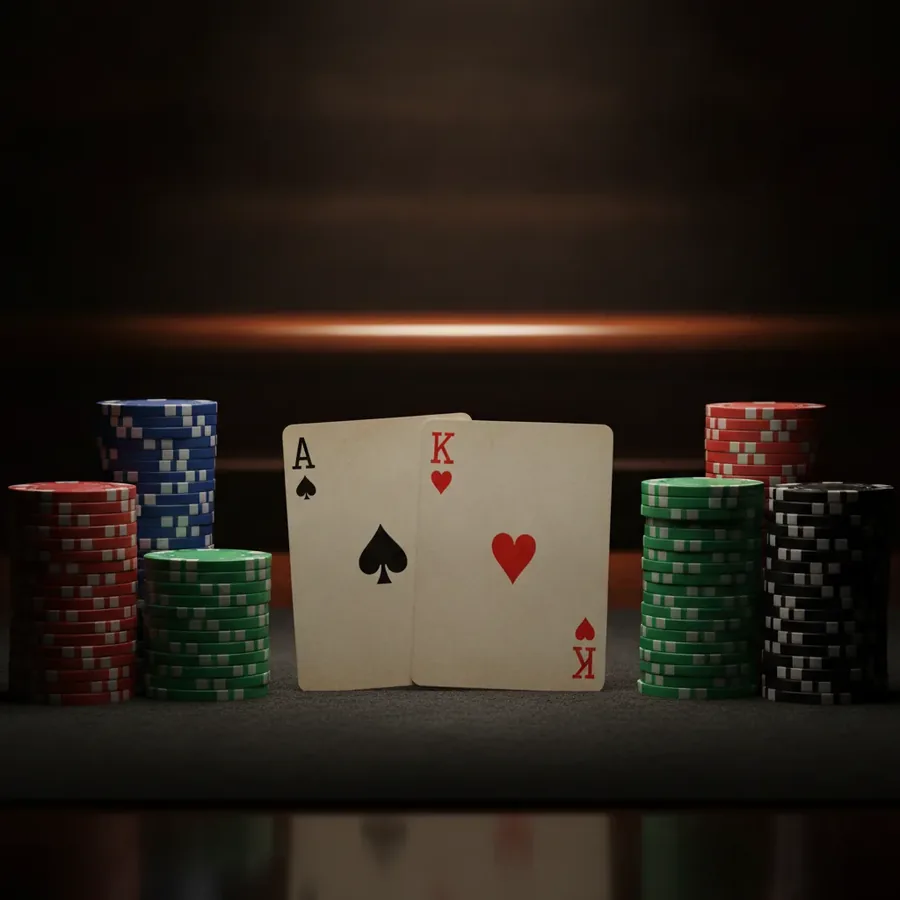
Mobile version needs 1 Mbit bandwidth
The live dealer games at Spinania, such as Infinite Blackjack from Evolution, are accessible on mobile devices requiring a minimum bandwidth of 1 Mbit. This specification ensures a stable connection for an optimal gaming session, allowing for uninterrupted play across various mobile platforms.
With a 1 Mbit bandwidth, players can engage with titles like Lightning Blackjack, also by Evolution, which features a special lightning multiplier system up to 25x. This bandwidth is generally sufficient for streaming live video feeds smoothly, a critical component for live casino engagement.
This bandwidth requirement ensures that side bets available in games like Infinite Blackjack, which include Any Pair, 21+3, Hot 3, and Bust It, are delivered without lag. Players can thus enjoy the full range of betting options and interactive features offered by Evolution's live casino suite.
Insurance Pays 2:1 Yet Still Costs Money
Blackjack Insurance, offered at Spinania for hands where the dealer shows an Ace, pays out at 2:1. However, despite the seemingly favorable payout ratio, this side bet carries a significant house advantage of 7.47% when using 6-8 decks, making it a statistically unfavorable option.
For example, a $10 bet on insurance pays $20 if the dealer has blackjack. Yet, the underlying RTP for this specific side bet is as low as 92.53%. Base strategy explicitly advises against taking insurance unless employing advanced card-counting techniques with a true count of +3 or higher.
In stark contrast to the main blackjack game, which can have an RTP as high as 99.85% in single-deck variants, the insurance bet actively diminishes a player's overall return. Taking insurance regularly, particularly at a 7.47% house edge, erodes potential winnings over time.
Splitting tens costs expected value: better stand
The rule regarding splitting tens, often encountered in blackjack variants, can negatively impact expected value. While specific figures for this rule's effect are not provided, general blackjack strategy dictates that splitting tens is usually not advantageous, unlike resplitting Aces which can improve RTP by 0.08 percentage points.
In most blackjack scenarios, a hand totaling 20 formed by two ten-value cards (10, J, Q, K) is a strong position. Attempting to split this into two separate hands typically results in a lower overall expected outcome compared to standing on the powerful 20.
This contrasts with beneficial rule modifications like doubling after splitting (DAS), which can improve RTP by approximately 0.14 percentage points. The decision to stand on tens, rather than splitting, preserves the strong starting value of the hand and aligns with optimal play to minimize house edge.
Blackjack Payout 3:2 Explained in Detail
A fundamental rule in many blackjack games at Spinania is the 3:2 payout for a natural blackjack, meaning a player receives 1.5 times their initial bet. For instance, a 100 EUR stake on a blackjack hand would yield 150 EUR, a significantly better return than the 6:5 payout.
The impact of a 3:2 payout versus a 6:5 payout is substantial; a 6:5 payout on a 100 EUR bet would only return 120 EUR. The difference of 30 EUR per blackjack is a direct reduction in the player's potential winnings, increasing the house edge by approximately 1.39 percentage points.
Games like Blackjack Ein Deck, which offers an RTP of 99.85% and a house advantage of just 0.15%, typically adhere to the favorable 3:2 payout. This payout structure is a critical factor in maintaining a low house edge, especially when combined with other player-friendly rules such as fewer decks.
Blackjack variants at a glance
| Variant | Payout | House edge | Rule | Bet range |
|---|---|---|---|---|
| Blackjack Auszahlung 6:5 statt 3:2 (6 Decks) | 98.15% | 1.85% | Ersatz von 3:2 durch 6:5 fügt exakt +1.39 Prozentpunkte zum Vorteil des Casinos hinzu – stärker als jede andere Regeländerung. Bei $10 Einsatz zahlt Blackjack $12 statt $15. | Blackjack 6:5, Gewinn 1:1 |
| Blackjack Liberal Vegas Strip (liberale Regeln, 3:2) | 99.72% | 0.28% | Günstigste Regelkombination: S17 + DAS + Resplit + Late Surrender. Standardabweichung 1,15 | Blackjack 3:2, Gewinn 1:1 |
| Blackjack Ein Deck, klassische Regeln, 3:2 | 99.85% | 0.15% | Weniger Decks = niedrigerer Vorteil; ein Deck gibt ca. −0.48 Prozentpunkte gegenüber 8 Decks. Oft durch 6:5 Auszahlung kompensiert. | Blackjack 3:2, Gewinn 1:1 |
| Blackjack Surrender (Late Surrender) – Regel-Effekt | n.a. (Regel-Modifikator) | −0.08 Prozentpunkte | Spieler gibt Hand nach Dealer-Blackjack-Prüfung auf, verliert die Hälfte des Einsatzes. Verbessert RTP um ca. 0.08 Prozentpunkte. Early Surrender ist wesentlich wertvoller (bis −0.6 Prozentpunkte), aber extrem selten. | Rückzahlung 50% des Einsatzes |
| Blackjack 6 Decks, S17, DAS, DOA, Auszahlung 3:2, Basisstrategie | 99.54% | 0.46% | Dealer steht auf Soft 17; Verdopplung auf jeder Zweierkarte; Verdopplung nach Split erlaubt; keine Aufgabe. Basisstrategie ist für diesen Wert zwingend | Blackjack 3:2, normaler Gewinn 1:1, Insurance 2:1 |
| Blackjack Insurance / Versicherung (6–8 Decks) | 92.53% | 7.47% | Separate Nebenwette bis 50% der Hauptwette, wenn der Dealer ein Ass hat. Basisstrategie schreibt IMMER Ablehnung vor (außer Karten zählen bei True Count ≥ +3). Bei einem Deck Vorteil ≈ 5.88% | Insurance 2:1 |
Insurance vs Even Money on Own Blackjack
The Blackjack Insurance side bet is offered when the dealer's upcard is an Ace, allowing a player to wager up to 50% of their main bet. This bet pays 2:1 if the dealer has a blackjack, but opting for it significantly increases the house edge to 7.47% with 6-8 decks, compared to a standard house edge of 0.28% for Blackjack Liberal Vegas Strip. Accepting insurance is generally ill-advised unless employing advanced card-counting strategies with a true count of +3 or higher.
In contrast, the 'Even Money' option is available to players who have achieved a blackjack themselves when the dealer's upcard is an Ace. This option allows the player to take an immediate 1:1 payout on their blackjack hand, foregoing the potential outcome of the dealer's hand. While it guarantees a payout, it forfeits the standard 3:2 payout for a blackjack, which would be 1.5 times the initial bet.
Choosing 'Even Money' when holding a blackjack against a dealer's Ace can be seen as a less risky, immediate payout strategy, particularly for players who prefer certainty over potential loss. However, for players focused on maximizing theoretical returns, accepting the standard 3:2 payout and playing out the hand, even if the dealer has an Ace, is mathematically superior, especially when considering tables with a more favourable house edge. The theoretical RTP for Blackjack Liberal Vegas Strip with a 3:2 payout is 99.72%.
Soft 17: Dealer Hits or Stands
The rule concerning the dealer's action on a soft 17 (a hand totalling 17 with an Ace counted as 11) can impact the game's house edge. When the dealer hits on soft 17, as seen in Blackjack Split / Double / H17, it increases the house edge by 0.22 percentage points. This rule is less favourable to the player as it provides more opportunities for the dealer to improve their hand.
Conversely, when the dealer stands on soft 17 (S17), this rule is more advantageous for the player, lowering the house edge. For instance, a Blackjack 6 Decks game with S17, DAS, DOA, and a 3:2 payout has a house edge of only 0.46%. This configuration, combined with basic strategy, offers a high RTP of 99.54%.
Players aiming for the lowest possible house edge should seek tables where the dealer stands on soft 17. The Blackjack Liberal Vegas Strip, for example, features a favourable combination of rules including S17, DAS, Resplit, and Late Surrender, contributing to its low house advantage of 0.28% and an RTP of 99.72%. Understanding these rule variations is crucial for optimizing player returns.
Card Counting at Shuffle Master Table: why it fails
Tables utilizing a Shuffle Master, or a continuous shuffling machine (CSM), are designed to continuously shuffle the cards after each hand or round. This process makes traditional card counting strategies ineffective because the composition of the deck is constantly reset. A CSM ensures that the deck's composition for the next hand is independent of previous outcomes, negating the ability to track card removal.
The primary reason card counting fails at these tables is the absence of a static deck from which to gain an advantage. In standard multi-deck shoes, players can track high cards being depleted, signalling a favourable deck composition for the player. However, with a continuous shuffling machine, such as those often found in automated blackjack variants, this predictive element is removed entirely.
This operational difference means that even with perfect basic strategy, a card counter cannot gain an edge over the house at a Shuffle Master table. The house edge remains constant, unaffected by the player's betting fluctuations or card tracking attempts. For example, standard blackjack games with a 3:2 payout typically have a low house edge, but this advantage cannot be exploited through counting when a CSM is in play.
When can you increase your bet?
For players employing basic strategy at a standard blackjack table, the optimal time to increase bet size is generally not dictated by hand outcomes but rather by a desire to leverage winning streaks or manage bankroll. However, for those who can accurately track cards, increasing bets is strategically advised when the remaining deck is rich in high cards. This situation signifies a lower house edge and a higher probability of player advantage.
In the context of live dealer blackjack at Spinania, variations like Infinite Blackjack and Lightning Blackjack accept bets from 1 EUR up to 5,000 EUR and 2,500 EUR respectively. While these offer high betting limits, traditional card counting advantages are diminished on tables with continuous shuffling machines. Therefore, increasing bets should primarily be based on bankroll management and personal risk tolerance rather than card counting at such tables.
A more structured approach to increasing bets would involve setting predetermined bet increments based on a percentage of one's total bankroll. For instance, a player might decide to double their bet after a win, or increase it by 50% after a loss, within predefined limits. This approach, coupled with the game's betting ranges such as 1 EUR to 1,000 EUR for Blackjack Party, allows for controlled variance in betting patterns.
Continuous Shuffling Machine shuffles after each round
Online blackjack variants that employ a Continuous Shuffling Machine (CSM) reshuffle the deck after every single hand is played. This automated process ensures that each new hand begins with a complete, freshly randomized deck, independent of any previous hands dealt from the same shoe. Games like Infinite Blackjack and Lightning Blackjack, both from Evolution, are examples where such technology is often utilized.
The primary implication of a CSM is the complete nullification of card counting strategies. Unlike traditional shoe games where card removal can be tracked to predict favourable conditions, a CSM resets the deck's composition after each round. This means that information gained from previous hands provides no predictive advantage for future hands, maintaining a consistent house edge throughout play.
For players, this means that any betting strategy aiming to exploit deck composition changes will be ineffective. The house edge remains constant, as exemplified by the RTP of 99.47% for Infinite Blackjack and 99.56% for Lightning Blackjack, which reflect the game's rules and not any player-exploitable card-tracking advantage. The most common RTP for standard blackjack, like Blackjack Liberal Vegas Strip, is 99.72%.
Infinite Blackjack vs Classic Seven-Seat Table
Infinite Blackjack offers an unlimited number of player positions, distinguishing it from traditional seven-seat tables. This allows more players to participate simultaneously without the constraint of limited seats, a key feature for high-traffic live casino environments. Evolution Gaming provides this variant, ensuring a dynamic gameplay experience that accommodates a vast player base.
While Infinite Blackjack boasts unlimited seats, a classic seven-seat table presents a more intimate setting where players directly interact with a finite number of other participants. The standard bet range for Infinite Blackjack is from 1 to 5,000 EUR, whereas Blackjack Party, another Evolution game, starts at 1.00 EUR and goes up to 1,000 EUR. This indicates varying accessibility across different live blackjack offerings.
The availability of multiple side bets in Infinite Blackjack, such as Any Pair, 21+3, Hot 3, and Bust It, adds layers of engagement beyond the core game. These side bets, coupled with the unlimited seating, create a significantly different player dynamic compared to a more constrained classic setup. The RTP for Infinite Blackjack is noted at 99.47%.
Step-by-step Split at the Live Table
Splitting pairs in live blackjack can significantly alter hand outcomes, particularly when dealt specific combinations at the live table. In Blackjack 6 Decks, the RTP stands at 99.54%, with a house edge of 0.46%, and doubling after split is permitted. This rule modification provides a strategic advantage to the player by offering more opportunities to improve their hand.
The ability to double after splitting (DAS) is a rule that benefits players by allowing them to double their bet on a split hand, further enhancing potential returns. This contrasts with tables where DAS is not allowed, thereby increasing the house edge. The base strategy for Blackjack 6 Decks mandates specific actions when such splitting opportunities arise.
When a player splits in live blackjack, they effectively create two new hands from their initial two cards, each receiving a fresh card. The allowance of doubling down on these newly formed hands, as seen in Blackjack 6 Decks, is a crucial aspect of liberal rules. This contrasts with situations where splitting is allowed but doubling after is not, impacting the overall RTP.
Four hours of play with 300 EUR bankroll
Engaging in live blackjack for four hours with a 300 EUR bankroll requires careful consideration of bet sizes and game RTP. Blackjack 6 Decks, with its 99.54% RTP and 0.46% house advantage, offers a relatively low edge. However, the actual duration of play is heavily influenced by bet frequency and amount.
If a player wagers 10 EUR per hand over four hours, approximately 240 hands could be played, assuming a fast pace of 60 hands per hour. With a 300 EUR bankroll, this bet size would allow for 30 hands before depletion, highlighting the importance of bet sizing relative to the bankroll. The house edge of 0.46% means that, on average, a small portion of each bet is retained by the casino.
The contribution of live casino games to bonus wagering requirements is often limited, with Tischspiele (table games) contributing only 10%. Therefore, playing live blackjack for four hours with a 300 EUR bankroll would contribute a mere 30 EUR towards a bonus turnover if the player had a 300 EUR bonus and a 40x wagering requirement (300 x 40 = 12,000 EUR total wagering needed).
Highroller from 500 EUR per hand
For high-stakes players betting 500 EUR per hand, the choice of live blackjack variant becomes critical due to the rapid accumulation of potential wins or losses. Infinite Blackjack allows bets up to 5,000 EUR, catering specifically to this segment of players. This high betting limit underscores the platform's capacity to accommodate significant wagers.
The RTP for Infinite Blackjack is 99.47%, which, while high, means a house edge of 0.53% is still present. On a 500 EUR bet, this translates to an average expected loss of 2.65 EUR per hand over the long term. This figure is substantially higher in absolute terms compared to lower stakes, emphasizing the importance of game rules.
The Lightning Blackjack variant offers multipliers up to 25x on winning hands, providing an additional layer of excitement for high rollers, albeit with an RTP of 99.56%. While this RTP is slightly higher than Infinite Blackjack, the allure of multipliers can significantly impact potential payouts, making it an attractive option for those betting 500 EUR or more per hand.
Double Down vs Simple Hit on 11
In blackjack strategy, doubling down on a hand totaling 11 is generally a favorable move, especially when facing a dealer's upcard that is not an Ace or a 10-value card. The Blackjack 6 Decks variant permits doubling down on any two cards, offering players this strategic option. This rule contributes to the game's 99.54% RTP.
A simple hit on 11 would mean taking another card, which is a more conservative approach. However, basic strategy dictates doubling down on 11 as it presents a strong opportunity to achieve a high total of 21. The house edge for Blackjack 6 Decks is 0.46%, indicating that strategic plays like doubling down are essential for players to mitigate this advantage.
The decision to double down or hit is informed by the dealer's visible card and the player's hand. In the context of Blackjack 6 Decks, where doubling after split is also allowed, the flexibility offered to the player is considerable. This contrasts with games that might restrict such actions, thereby increasing the house advantage or lowering the player's return.
Contact
Live - online chat
Banking







Providers












Spinania Casino 2026